
Table of Contents
Why revenue attribution breaks after the first sale?
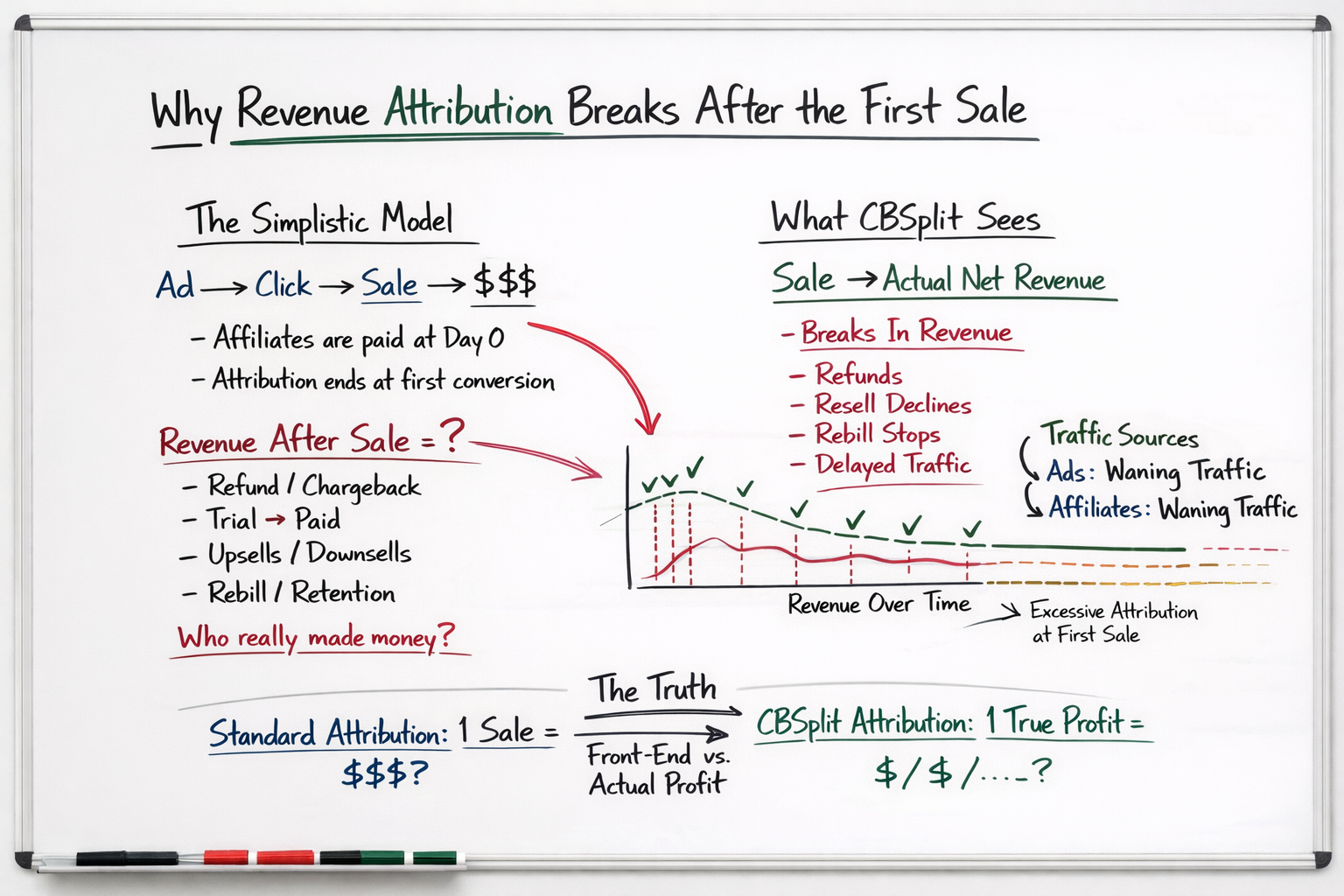
Traditional affiliate attribution assumes revenue is fully understood at the moment of the first sale.
CBSplit exists because this assumption fails in real subscription and rebill-driven businesses.
Attribution does not end at the first sale. Reality begins after it.
The traditional attribution model
Most affiliate systems follow a simple model:
- Ad → Click
- Click → Sale
- Sale → Commission
Once the first transaction is recorded, attribution is considered complete.
This model assumes revenue is immediate, final, and stable.
That assumption is incorrect.
What happens after the first sale
In real-world funnels, the first sale is only an entry point.
Revenue after the sale is affected by:
- Refunds and chargebacks
- Trial-to-paid conversion failures
- Upsells and downsells
- Subscription churn
- Failed rebills
- Payment processor declines
- Delayed cancellations
Standard attribution systems do not observe these events correctly.
Why attribution breaks
Revenue attribution breaks because it is:
- Front-loaded
- Time-blind
- Outcome-agnostic
Affiliates are often credited and paid on Day 0, while revenue reality unfolds over weeks or months.
When refunds or churn occur later, attribution is not corrected.
The attribution mismatch
Standard attribution answers:
Who caused the first transaction?
CBSplit asks:
Who generated durable, net-positive revenue?
This mismatch causes:
- Overpayment to low-quality traffic
- Undetected refund-heavy sources
- Misleading campaign performance data
- Scaling of unprofitable funnels
What standard dashboards fail to show
Most dashboards display:
- Gross revenue
- Initial conversions
- Affiliate payout totals
CBSplit exposes what is missing:
- Revenue decay over time
- Rebill survival curves
- Source-level refund ratios
- Net revenue after all adjustments
- Long-term traffic quality trends
Attribution appears correct until these layers are examined.
CBSplit’s approach to attribution
CBSplit treats attribution as a time-based system, not a single event.
It aligns credit with:
- Revenue actually collected
- Revenue that survives refund windows
- Subscription continuity
- Net profitability per source
Attribution is continuously re-evaluated as revenue evolves.
Why first-sale attribution creates false winners
Traffic sources that perform well on Day 0 often fail long-term.
Common patterns include:
- High initial conversions
- High refund rates
- Poor rebill retention
- Rapid revenue decay
Without post-sale attribution, these sources appear profitable when they are not.
This is why revenue attribution breaks after the first sale.