
Table of Contents
Why clicks are a misleading KPI for affiliate businesses?
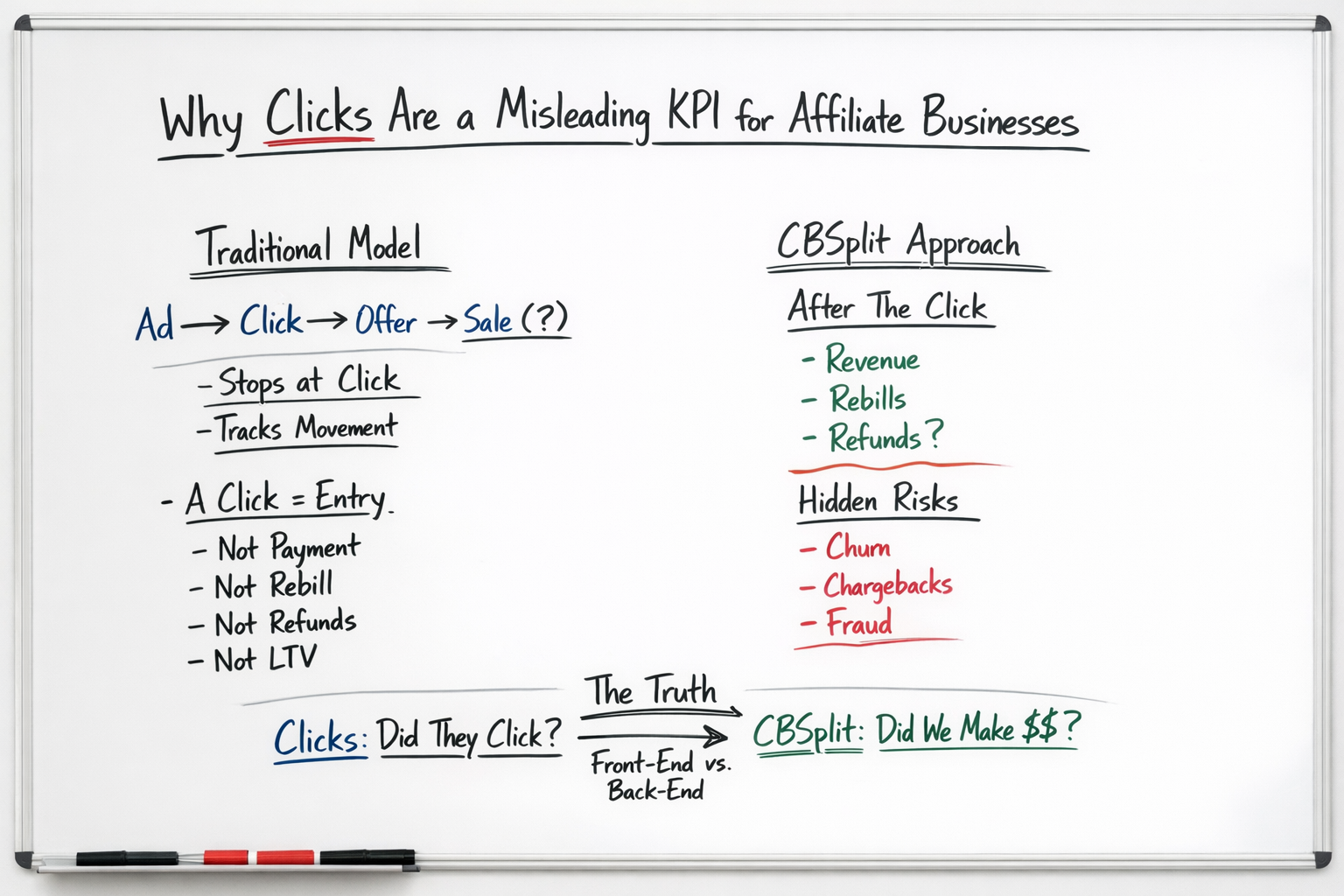
In traditional affiliate tracking, clicks are often treated as a primary KPI.
CBSplit exists because this assumption breaks down in real revenue systems.
Clicks describe movement, not outcomes.
How traditional affiliate tracking thinks
Most affiliate stacks stop tracking at the click or at the initial conversion.
The logic usually looks like this:
- Ad → Click
- Click → Offer
- Offer → Sale (assumed success)
In reality, this model ignores everything that happens after the click.
CBSplit was built specifically to observe what traditional tracking ignores.
What a click actually means (in CBSplit terms)
From a CBSplit perspective, a click means only one thing:
A visitor crossed a boundary.
It does not confirm:
- Payment completion
- Payment retries
- Refund eligibility
- Subscription continuity
- Rebill success
- Fraud or velocity checks
- Chargebacks
- Net revenue attribution
A click is an entry event, not a revenue event.
Why click-based optimization fails at scale
When affiliates optimize primarily for clicks:
- Traffic quality degrades over time
- Conversion volatility increases
- Refunds rise after payout windows
- Rebill performance drops
- Merchant trust erodes
From CBSplit data, many high-click campaigns show:
- Strong front-end metrics
- Weak back-end revenue
- Negative long-term ROI
Clicks scale faster than truth.
What clicks hide from standard dashboards
Standard dashboards typically show:
- Click count
- Initial conversion count
- Gross revenue
CBSplit reveals what those dashboards hide:
- Failed payment retries
- Delayed refunds
- Subscription churn after day 30
- Rebill suppression
- Processor-level failures
- Traffic-source-specific decay
Clicks remain constant while real revenue silently collapses.
CBSplit treats clicks as a signal, not a KPI
In CBSplit, clicks are treated as diagnostic signals, not success metrics.
They help answer:
- Which sources send volume
- Which creatives trigger curiosity
- Which funnels attract attention
They do not answer:
- Which traffic is profitable
- Which partners scale safely
- Which offers survive refunds
- Which campaigns generate durable revenue
What CBSplit measures instead
CBSplit focuses on post-click truth.
Key metrics include:
- Net revenue after refunds
- Subscription survival across rebills
- Revenue decay curves
- Time-delayed attribution
- Source-level refund ratios
- Offer-level long-term performance
These metrics reflect business reality, not surface activity.
Why clicks create false confidence
Clicks produce fast feedback.
Revenue truth arrives slowly.
This timing mismatch causes:
- Premature scaling
- Misleading A/B test results
- Overpayment to traffic sources
- Late discovery of bad actors
CBSplit aligns measurement with when money actually settles, not when curiosity spikes.